
From the newsroom to the shop floor: an interview with Anna Soboleva
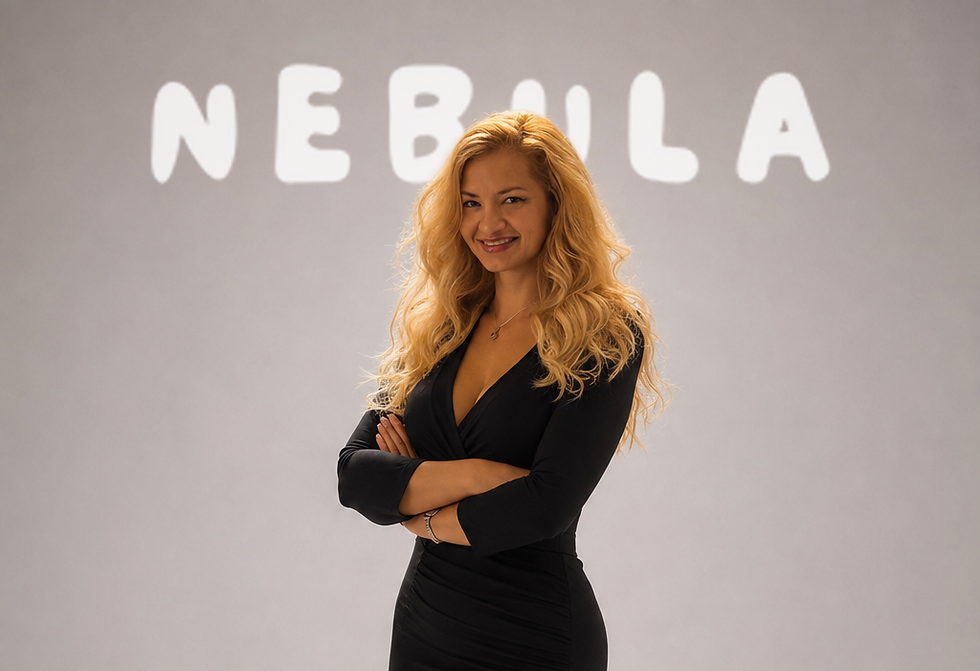
I've worked alongside Anna Soboleva, founder of Nebula, for a while now, and I still don't think I've heard her origin story told properly. So I sat her down and asked.
Carol: You've got a genuinely unusual background for someone doing marketing for engineering and manufacturing firms. Where does it actually come from?
Anna Soboleva: Before Nebula, I wasn't in marketing at all. I have a science background, biology and genetics, with a Master's in Conservation and Evolution, and before that I worked as a journalist. On paper those two things don't obviously lead to marketing for technical businesses. But they're exactly what this work needs. Science teaches you to do proper research, to be sceptical of claims, and to want evidence before you believe something. Journalism teaches you to ask questions, to investigate, to stay curious, and to take something complicated and explain it so a busy, non-expert person actually understands why it matters. Put those together and you get someone who doesn't glaze over when an engineer starts explaining tolerances or material specs, and who also won't let a client publish a claim we can't back up. That combination is rarer than you'd think, and it's the whole reason I can sit across from a technical founder and actually follow what they're telling me.
Carol: When you sit down with an engineering or manufacturing founder for the first time, what's the thing they almost always get wrong about their own marketing?
Anna Soboleva: Two things, mostly. First, they generally don't know what's actually available to them. Marketing has changed enormously in the last five years alone, and most technical founders are running a business, not keeping up with it, so they simply don't know the tools and channels that exist now.
Second, and bigger: they think marketing is a one-off fix. They imagine you hire someone for a month, or you get a new website built, and that's the job done. It isn't. A website is never finished. It needs constant updates, speed and ranking work, SEO, and increasingly what people are calling GEO, AEO and AIO, being findable and citable by AI systems, not just search engines. You need a steady stream of content, you need backlinks, and none of that is a one-month job. It's ongoing, permanent work, because you're not just building something once, you're constantly building on what's already there so none of it goes to waste. I'd always rather a client commit to a smaller, steady amount of work every month than a big push once and then nothing for the rest of the year. Consistency compounds. A single burst doesn't.
There's a third thing too, which is pricing. Most technical founders have no real sense of what marketing should cost, so they either overpay wildly for something a smaller agency could do just as well, or they try to negotiate down a price that's already at the floor. The honest answer is that marketing pricing genuinely spans from a few hundred pounds a month to seven figures, and where you sit on that range depends on how you position yourself, how bold or confident you're willing to be about your own value, and how big you are. The bigger the price tag, the bigger the responsibility to actually deliver against it. It's not a fixed market rate the way, say, an accountant's hourly rate roughly is. It's closer to a negotiation shaped by confidence and positioning on both sides.
Carol: Is there a project, or a pattern, that changed how you think about this work?
Anna Soboleva: Every project throws up something new, honestly, which is part of why I still enjoy this. But there's a pattern I run into often enough that I'd call it a rule rather than an exception: I'll be brought in for something specific, a website rebuild, say, and partway through it becomes obvious that the real problem sits one level up, in the commercial strategy itself. The website was never going to fix it on its own. When that happens, I always flag it, even though it's outside what was actually paid for. I'd rather a client know the real shape of their problem than have me quietly deliver the narrower brief and let the bigger issue sit there unaddressed. It's not always welcome in the moment, but it's the honest thing to do, and it's usually the thing they remember afterwards.
Carol: Networking in this world runs on trade shows, chambers, referrals, people who've known each other for twenty years. How does a smaller, newer outfit actually break in?
Anna Soboleva: You can't afford to write off any of it, but trade shows and conferences are only the most visible layer. There's a whole second layer that people underestimate: chambers of commerce, growth hubs, business incubators, masterclasses, and more specialist-interest networks that don't look like "business networking" on the surface but function exactly that way, golf, for instance, or polo. People do genuine business in there precisely because nobody's pitching. The overrated end, in my experience, is walking a trade show floor collecting business cards with no real conversation attached. The underrated end is anywhere with a smaller room and enough time for an actual conversation to happen. That's where relationships, and eventually work, actually come from.
Carol: You just mentioned some of those rooms, golf, polo, chambers. Is it different for you walking into them as a woman?
Anna Soboleva: It can be, yes, particularly in an industry as male-dominated as engineering. I'm a fairly calm, quiet presence rather than a loud one, and some men assume quiet means inexperienced, which occasionally gets used against you. I've had conversations where something was said to me directly, and then later denied outright, as though it never happened. I don't think that happens nearly as often when the other person in the room is a man. A man's word tends to be taken as given. With women, something shifts, and you have to actively hold your ground and keep asking yourself: am I actually being treated fairly here, or am I being taken advantage of? It's not just a feeling, either. The gender pay gap across the UK currently stands at 12.8% (ONS, 2025), and in engineering specifically it's estimated at around 11%. Women in this industry are still being paid meaningfully less than men. It's worth technical businesses sitting with that number for a moment, because it says something about who gets heard in this industry, and who doesn't.
David Milnes, founder and director of KyteMark, helped me at some point with exactly this. Sometimes it is just a few honest conversations, that's all it takes to start believing in yourself. What's stuck with me since is his idea of a superhero coat: the best version of yourself that you put on every time you feel uncomfortable, and that gives you strength. It actually worked.
Carol: If you had to name one belief about marketing for technical businesses that the industry gets wrong, what would it be?
Anna Soboleva: That one person can be the whole marketing function, and that if they just work hard enough, it'll come together. It won't. I know that first-hand, because that's exactly how I started. Serious companies that understand marketing treat it as a department made up of different roles and skills, not one person doing strategy, copywriting, design, website admin and events simultaneously. A lot of businesses still expect exactly that from one hire, on a shoestring budget, and then wonder why the results are thin. The honest maths is that the employer pays twice: once for the underpowered output, and again in the burnout and resentment of the person carrying a job built for several people. It never produces the results the business actually wanted, and it costs someone their health along the way. I try to run my own principles through my business decisions too, and that trade-off has never looked worth it to me.
Carol: You mentioned public relations as one of your strengths. What's the gap you keep seeing there?
Anna Soboleva: Engineering firms, in particular, massively underuse the free publicity that's sitting right in front of them. I've seen companies pay for editorial placements when they had decades of genuine, hard-won engineering expertise that trade press would happily publish for free, if only someone framed it properly and sent it to the right editor. All it takes is a marketer who actually understands public relations, which, given my journalism background, is something I'm particularly comfortable with.
More broadly, I think every business, not just engineering firms, needs to reassess how AI-friendly its own channels are. The way people find information has shifted: increasingly, someone asks an AI assistant who does something before they ever land on a company website. That means having the right structured information out there for AI systems to actually find and cite matters as much now as ranking on Google once did.
Carol: Speaking of marketing catching people off guard, has anything done that to you personally recently?
Anna Soboleva: Actually, yes, and it was one of my own industry's colleagues. I was at Technology for Marketing last year, and their retargeting ad this year was genuinely the best-targeted ad I've ever seen aimed at me personally. Last year I attended the show; this year, their ad featured people sitting in chairs, and I was right in the centre of the group. I'm still thinking about that weeks later. That's a level of marketing craft I have to respect, even as the person it was aimed at.
Carol: Was landing on the name "Nebula" actually difficult, given how much rides on a name like that?
Anna Soboleva: Honestly, no, not difficult at all. It was the first name I thought of, and it came to me quite naturally, without days of turning it over. I think that's because I've always been drawn to the sky, to space, to stars. There's a line from Nikolai Roerich, the Russian painter, that's stayed with me for years. Translating it myself from the Russian: "If you like to look at the starry sky, if it attracts you with its harmony and astonishes you with its vastness, it means a living heart beats in your chest, one that can resonate with the innermost truths about the life of the Cosmos." That's from his book Seven Great Mysteries of the Cosmos. I also love the opening of W. H. Auden's poem "The More Loving One": "Looking up at the stars, I know quite well / That, for all they care, I can go to hell." And in a way, a nebula is exactly the right image for what marketing actually does. It's the region of space where stars are born, and also where they eventually die. That's the same territory marketing works in: it's where an idea, a brand, a company either catches and comes to life, or never quite ignites at all.
Carol: What surprised you about actually running Nebula, day to day, versus what you expected going in?
Anna Soboleva: It's still early days, but it's growing steadily now. What surprised me was the fear at the very start. No fixed salary, and that quiet, constant worry about how the bills get paid. Taking that step into the unknown is genuinely frightening. It reminded me of jumping out of a plane with a parachute, alone. I still don't fully understand what made me actually step out of that plane, but I did, and it was one of the more intense things I've felt. Starting Nebula had the same shape to it: real fear, and then you do it anyway. As the saying goes, the person who never takes a risk never gets the champagne.
Anna Soboleva is the founder of Nebula, a marketing consultancy for UK engineering, manufacturing and technical businesses.
By Carol Whitmore, Head of Research, Nebula
Comments